



THE most disrupted sections of the A64 between York and the Yorkshire coast have been revealed in newly released data.
Analysis supplied by National Highways through a Freedom of Information (FoI) request shows that the A64 was affected by 671 closure shifts totalling more than 5,224 hours between January 2020 and October 2026.
The figure is equivalent to almost 218 days of closure activity across the route.
The FoI data, obtained by the Local Democracy Reporting Service (LDRS) indicates that some sections of the road were repeatedly affected by major maintenance and improvement schemes, generating hundreds of hours of disruption for motorists heading to and from Scarborough, Whitby, Filey and the wider coast.
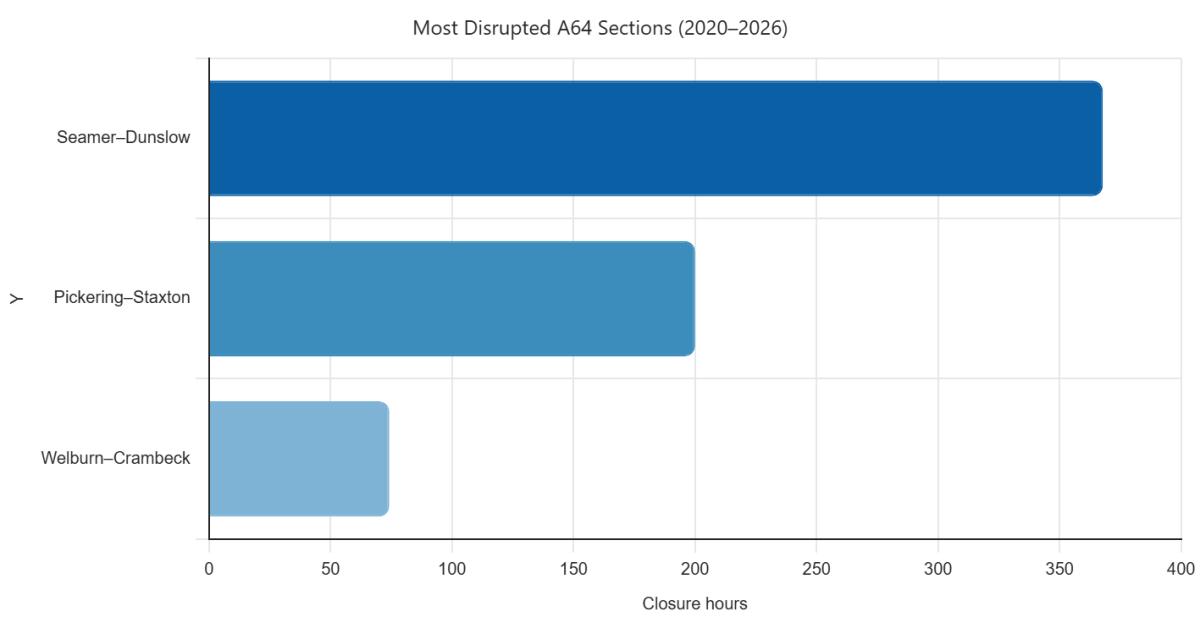
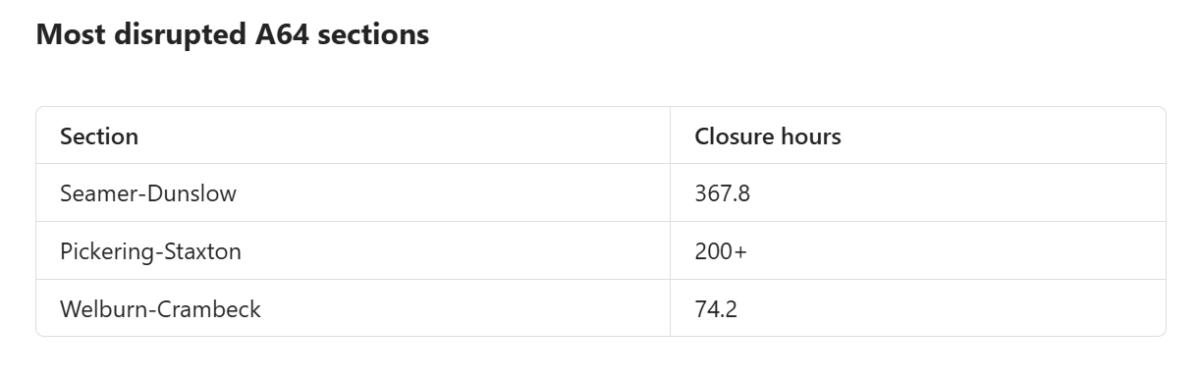
According to National Highways, the stretch between Seamer and Dunslow experienced the greatest recorded disruption, with a major improvement scheme accounting for 50 closure shifts and almost 368 hours of closures.

Works between Pickering and Staxton also featured heavily in the data, generating more than 200 hours of closures, while other major programmes took place between Welburn and Crambeck, Musley Bank and Malton, and Hopgrove and Claxton.
In an accompanying methodology report, National Highways said major improvement projects represented “the most significant source of roadspace occupation” on the route, while routine maintenance work generated the largest number of individual closures.
The agency added: “Programmed Routine Works form the largest volume of individual closures” and noted that: “Traffic incidents account for a very small proportion of total events.”

However, while planned works accounted for most closure hours overall, some of the longest individual disruptions were caused by unexpected incidents.
The longest unplanned closure recorded during the period occurred in February 2021, when a police-led incident closed the westbound carriageway between the A1036 and A1237 for more than 32 hours.
Another police-led incident near Seamer in August 2020 resulted in almost 10 hours of disruption.
Read more
The methodology report states: “Traffic incidents therefore represent the highest level of operational uncertainty within the portfolio.”
A spokesperson for National Highways said: “The A64 is a key route linking Leeds, York and coastal communities, and it’s vital that maintenance work is carried out so that it continues to operate safely and effectively.
“This reduces the chance of unexpected closures in the future.
“Our work is carefully planned, and we’ll continue to review our activities to minimise disruption as much as possible, while maintaining safety.”
The figures have renewed debate about long-term investment in the route, which is frequently cited by businesses, tourism operators and politicians as one of the Yorkshire Coast’s most important transport links.
Kevin Hollinrake, MP for Thirsk and Malton, previously described the closure figures as “stark but sadly unsurprising” and argued they highlighted the need for further investment in the corridor.
Meanwhile, National Highways has confirmed that feasibility work on potential safety improvements at the Common Lane and Towthorpe Moor Lane junctions is expected to continue until the end of 2027.


Share