



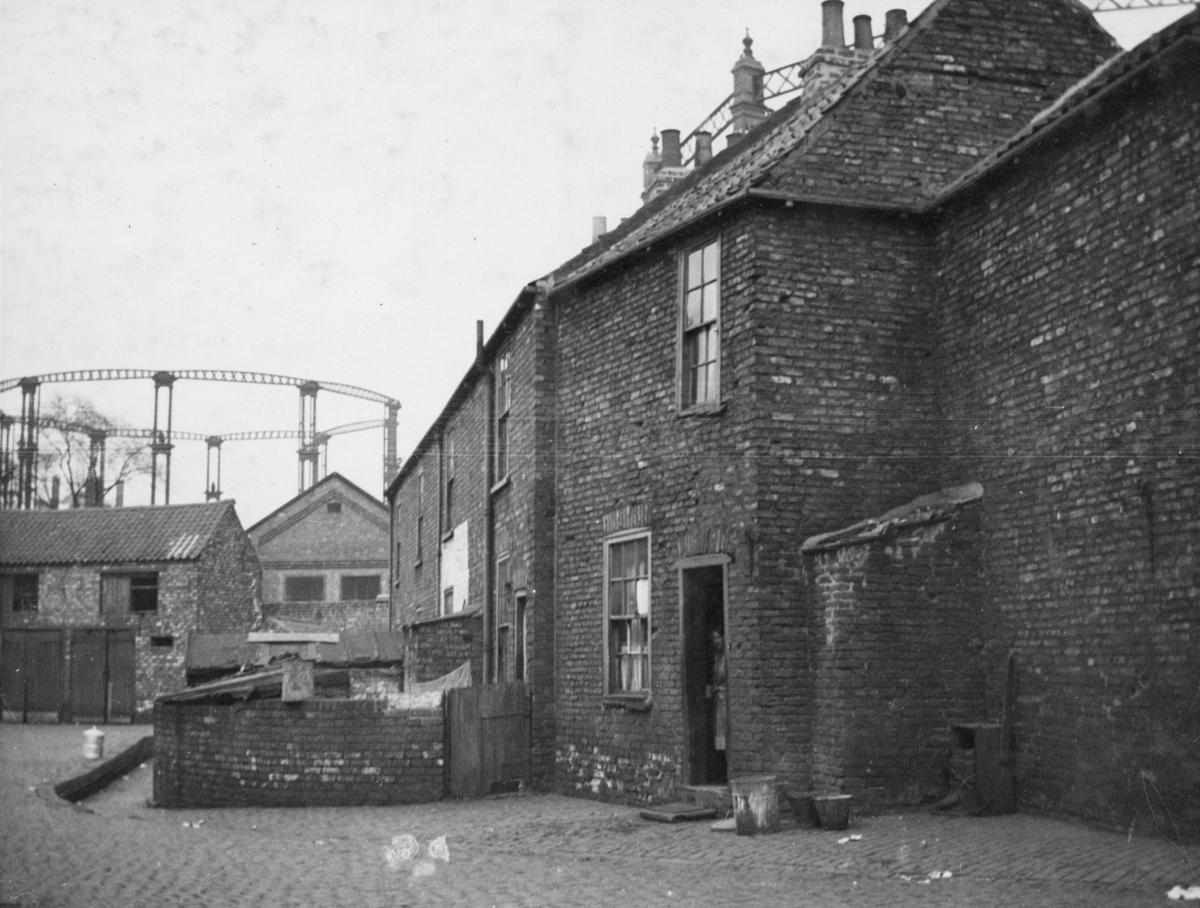


AN 'industrial landscape of some grandeur'. That's how John Hutchinson and DM Palliser described the old York gasworks which once stood on Foss Bank (where Sainsbury's is now) in their York City Guide, published in 1980.
Looking at our main image today, you can see exactly what they meant.
The photo (we’re not sure of the date: can any readers make a guess?) shows the curve of Foss Bank in the foreground, with just a hint of the River Foss itself in the bottom right corner.
In the distance, the Minster rises majestic against the skyline. The former York County Hospital building can also be seen in the middle distance, to the left of the photograph, and in the bottom right corner you can just make out the bridge which linked this western section of the gasworks to the other section across the river off Heworth Green.
But it is the gasworks itself which dominates.
It is a scene straight out of a Victorian past. A tall, grim, mill-like main building; a huge main chimney; smaller chimneys belching smoke or steam. Hard to believe that this could ever have existed almost right in the heart of York.
Yet the gas works were still operating (as part of the NorthEastern Gas Board) within the living memory of many Press readers. Lots of you will no doubt know people who worked there: some of you may even have worked there yourself. We’d love to hear from anyone who has stories to tell or old photos to share...
It was the demand for gas lighting that initially drove the arrival of a gasworks in York almost 200 years ago.
Gas was the new lighting technology of its day, which promised to provide ‘brilliant illumination’ to replace the ‘dull and murky glare’ of oil lamps.
The York Gas Light Company was incorporated in 1823, according to A History of the County of York edited by PM Tillott and published in 1961.
The company seems to have been something of a community venture: 104 York citizens were named as the first subscribing members.
“The company was to supply the city and suburbs, and gas lighting was in use in streets and shops by March 1824; the manufacturing plant occupied a site of about two acres near Monk Bridge on the west bank of the Foss,” the History of the County of York reports.
The new lighting was expensive, however. In 1828 the city temporarily returned to oil-lighting when the city commissioners and the York Gas Light Company (YGL) disagreed about the charges. There was clearly a bit of brinksmanship going on, and since YGL had a monopoly, it presumably held the upper hand. But eventually the two sides agreed a price, and the city commissioners announced that ‘the entire number of winter lamps - 250 - would be lit during the music festival’. It must have caused quite a sensation.
YGL didn’t have things all its own way for long, however.
By 1837, a rival company - the York Union Gas Light Company (YUGL) - had been established to break its monopoly and to lower prices. By January 1837 it had already received permission from the city corporation to lay pipes from its works next to the Foss in Hungate. But the York Gas Light Company, which had been on the scene in York first, wasn’t going to take the arrival of a brash young competitor lying down. The Union Gas Light Company workmen who began to try to lay pipes in February ‘were hindered by those of the YGL,” the History of the County of York relates. We'd love to know what form that 'hindrance' took. We're quite sure it wasn't as harmless as that dry description maks it sound...
The York Union Gas Light Company was finally able to start supplying gas in October 1837 - only to find itself being sued by the YGL for damaging the earlier company’s mains. YGL was eventually awarded ‘extensive damages’, the History of the County of York reports.
Such ‘gas wars’ couldn’t continue. In 1844 the two companies amalgamated as the ‘York United Gas Light Company’, and peace - and decent illumination - broke out. The Monk Bridge site was extended, and the rival Hungate site was sold to Henry Leetham, the miller, in 1850.
There was still the issue of the cost of gas. In 1850 a fresh argument broke out with the city corporation over the price of gas - the corporation even briefly considered building its own gasworks.
But the dispute was eventually settled by arbitration, and thereafter the York United Gas Light Company expanded steadily. In 1878, six acres of land were bought on the east bank of the Foss. A new works was built there between 1880-1885, and linked to the old works on the other side of the Foss by a bridge.
In 1912 the company changed its name to the York Gas Company and by 1923 it was supplying more than 22,000 customers in York.
It was nationalised in 1948 and came under the control of the NorthEastern Gas Board, which had its offices and showrooms in Davygate.
But in 1958 York was connected to the national gas grid (by a 32-mile long pipeline which ran all the way to Tingley near Bradford).
The days of the York gasworks were numbered.
The gas containers which stood on both sides of the Foss continued to be a very distinctive feature of this part of York right up until modern times, however.
Stephen Lewis


Share